
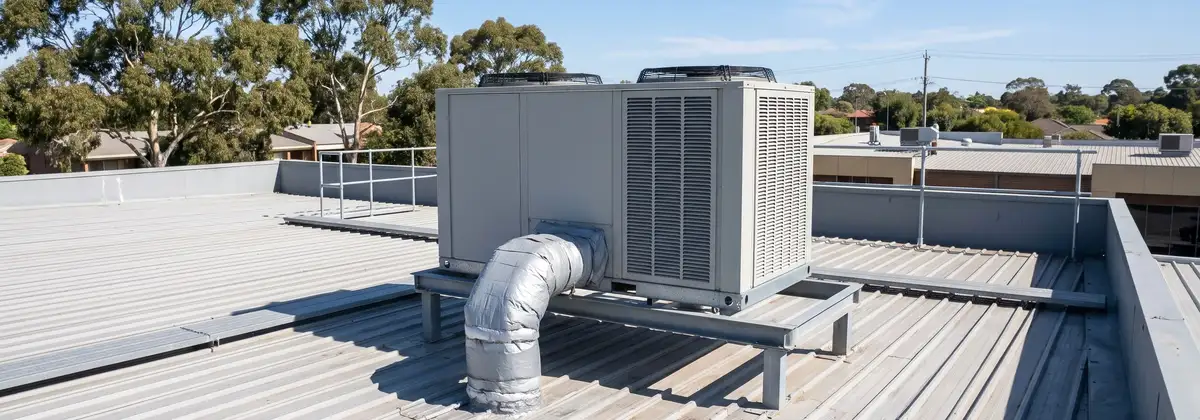
Packaged air conditioners put every component in one outdoor cabinet. The compressor, condenser, evaporator coil, fan and filter all sit together in a single box on the roof or on a slab beside the building, and conditioned air is fed inside through ductwork.
Compare that with a split system, where the compressor sits outside and the coil and fan sit inside, joined by refrigerant pipes.
Where packaged units are used
In Australia, packaged units are mostly a commercial product. You will see them on the roofs of shops, offices, schools, clubs and small industrial buildings, where people usually call them packaged rooftop units.
In housing they turn up occasionally on homes with no roof space for a ducted indoor unit, on some transportable and modular buildings, and on older installations. For most Australian homes, a ducted or split system suits better; the Australian Government’s heating and cooling guide compares the options.
Advantages
- All the noisy and serviceable parts are outside the building
- No indoor plant space needed, which frees up roof or cupboard space
- Simpler installation than a ducted split, because there is no refrigerant pipe run between an indoor and an outdoor unit
- Servicing is straightforward, since everything is in one accessible place
Disadvantages
- The whole unit sits out in sun, rain, hail and salt air, which shortens its life compared with a system whose indoor half stays protected
- Generally less efficient than a modern ducted split system
- Needs ductwork, so it carries the same building constraints as ducted air conditioning
- Roof-mounted units need structural support and safe roof access for servicing
- Limited residential model range in Australia, so fewer choices and fewer installers who fit them
- Not required to carry a Zoned Energy Rating Label, which makes efficiency harder to compare
Is a packaged unit right for my home?
Usually not, and it is rarely a choice a homeowner makes deliberately. Where an installer proposes one, it is normally because the home genuinely cannot accommodate an indoor fan coil unit.
If an installer recommends a packaged unit, ask:
- Why this instead of a ducted split or multiple split systems?
- What is the expected service life, given it sits fully out in the weather?
- Where exactly will it sit, and what structural work does it need?
- What will it cost to run compared with the ducted alternative?
If an installer offers a ducted split instead, our brand reviews compare the main ducted brands’ ranges and warranties.