
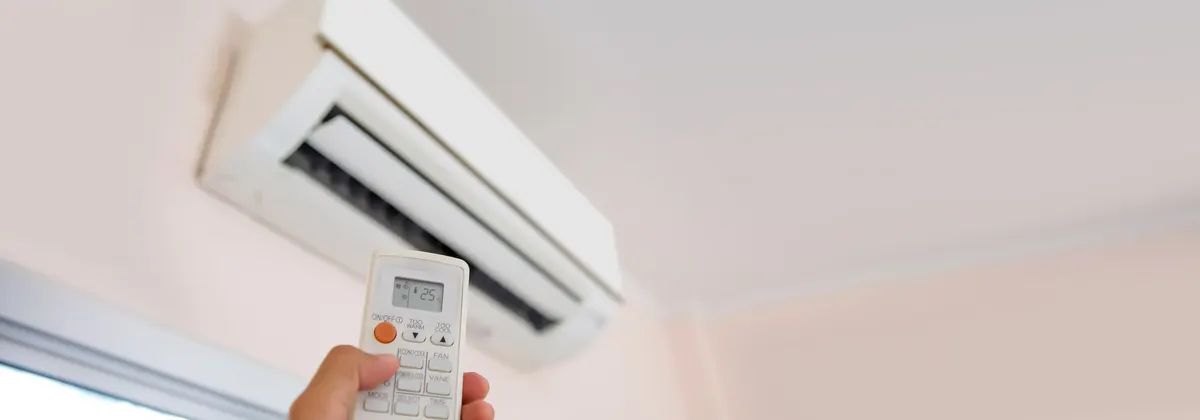
To work out air conditioner running costs, multiply the system’s estimated annual energy use, from its energy label, by your electricity tariff. In the Australian Government’s own worked example below, a large 8.5kW split system in a hot climate costs about $1,050 a year to run. A typical bedroom-size split in an average climate costs about $237 a year at the same tariff.
Your figure depends on the system, your climate, your tariff and how you use it, and you can work it out for any system you are quoted, using information the manufacturer is required to publish. Here is how.
The calculation
Annual running cost = estimated annual energy use (kWh) x your electricity tariff ($ per kWh)
Where to find the energy use on the Zoned Energy Rating Label. Every air conditioner that must carry the label shows estimated annual energy use in kilowatt hours, separately for cooling (in blue) and heating (in red), for each of three climate zones: hot, average and cold. Use the figure for your zone. Find your zone with the Energy Rating Calculator.
Where to find your tariff on your electricity bill, in the usage or tariff section. Rates vary a lot with your state, your distribution network and your plan.
Use your own figure rather than an average. The running cost moves in step with the rate: on a tariff a third higher, the same system costs a third more to run.
A worked example
This example is published by the Australian Government’s energy rating scheme (energyrating.gov.au).
A reverse cycle, non-ducted single split system with 8.5kW cooling and 10kW heating capacity, installed in a hot climate zone, rated 6.5 stars for cooling and 3 stars for heating:
- Estimated annual energy use: 2,254 kWh (2,047 kWh cooling plus 207 kWh heating)
- Electricity tariff: $0.4659 per kWh
- Estimated annual running cost: $1,050, made up of $954 for cooling and $96 for heating
Note how lopsided that is. In a hot zone, nearly all the cost is cooling. In a cold zone the split runs the other way, which is why you compare the figures for your own climate rather than a national average.
Note that this example uses its own assumed tariff of $0.4659 per kWh. Substitute your own tariff and your own zone’s kWh figure and you have a realistic estimate for that model.
A bedroom-size split in an average climate
The Government’s example is a large unit in the hottest zone, the top of the range. For a bedroom, we took the Australian Government’s Energy Rating register, as at : of the 225 wall-mounted reverse cycle split systems of 2.0 to 3.0kW registered for sale, the one in the middle for yearly energy use. It is a 2.5kW unit. In the average climate zone, at the same tariff of $0.4659 per kWh:
- Estimated annual energy use: 507 kWh (145 kWh cooling plus 362 kWh heating)
- Estimated annual running cost: $237, made up of $68 for cooling and $169 for heating
- Running flat out at its rated cooling output it draws 0.49kW, about 23 cents an hour. An inverter model runs below that once the room is at temperature
Source: Energy Rating data, Australian Government Department of Climate Change, Energy, the Environment and Water, licensed under CC BY 3.0 AU. Data as at .
Which systems have a label
Mandatory in store for single-phase, non-ducted, unitary or single-split air conditioners up to 30kW.
Not required for ducted systems, multi-split systems, three-phase systems, evaporative coolers and systems over 30kW. Some manufacturers display a voluntary label on ducted and three-phase models.
Where a system has no label, ask the installer for the estimated annual energy consumption in writing, so you can compare quotes on the same basis.
How system types compare on running cost
Roughly, from cheapest to dearest per unit of cooling delivered:
1. Ducted evaporative cooling Uses less than half the electricity of a refrigerated air conditioner of similar capacity (energy.gov.au), because it is essentially a fan and a water pump. Only suits dry climates, cools only, and uses water.
2. Split system (inverter, reverse cycle) Very efficient. Reverse cycle systems on the Australian market deliver roughly three to six units of heating or cooling per unit of electricity (energy.gov.au).
3. Ducted reverse cycle Slightly less efficient than a wall split, because the fan is larger and some energy is lost through the ductwork. Zoning claws a lot of that back, provided you actually use it. Still much cheaper to run than ducted gas heating.
4. Window or wall unit Less efficient than a comparable split system.
5. Portable air conditioner The dearest to run per unit of cooling. Portable air conditioners carry a zero-star energy efficiency rating, because the compressor sits in the room with you and the vent hose lets hot air back in.
Heating: why reverse cycle is the cheap option
An electric bar or fan heater turns one unit of electricity into one unit of heat, and no electric heater can beat that.
A reverse cycle air conditioner moves heat rather than making it, and delivers roughly three to six units of heat per unit of electricity (energy.gov.au). That is why it is generally the cheapest way to heat an Australian home, and why several states now offer discounts for replacing gas heating with it.
Eight ways to cut what yours costs
- Set a sensible temperature. 25 to 27 degrees in summer, 18 to 20 in winter (YourHome). Every extra degree changes energy use by roughly 5% to 10% (energy.gov.au)
- Use zoning. Run only the parts of the house you are in
- Close doors to rooms you are not conditioning
- Seal draughts around doors and windows. The cheapest efficiency upgrade there is
- Manage the sun. Close curtains before the room heats up, and shade windows externally where you can
- Start before it gets hot, rather than pulling a hot house back down
- Use a fan alongside it. A fan costs about 2 cents an hour and makes you feel about 3 degrees cooler (energy.gov.au), which lets you set the thermostat higher
- Clean the filters every two to four weeks in heavy use. A blocked filter cuts capacity and raises cost
Running cost beats purchase price over time
Across a ten to fifteen year life, what a system costs to run usually exceeds what it cost to buy. When you are comparing two quotes, work out the annual running cost of each, multiply by ten, and add it to the purchase price. The cheaper system on day one is often not the cheaper system overall.