
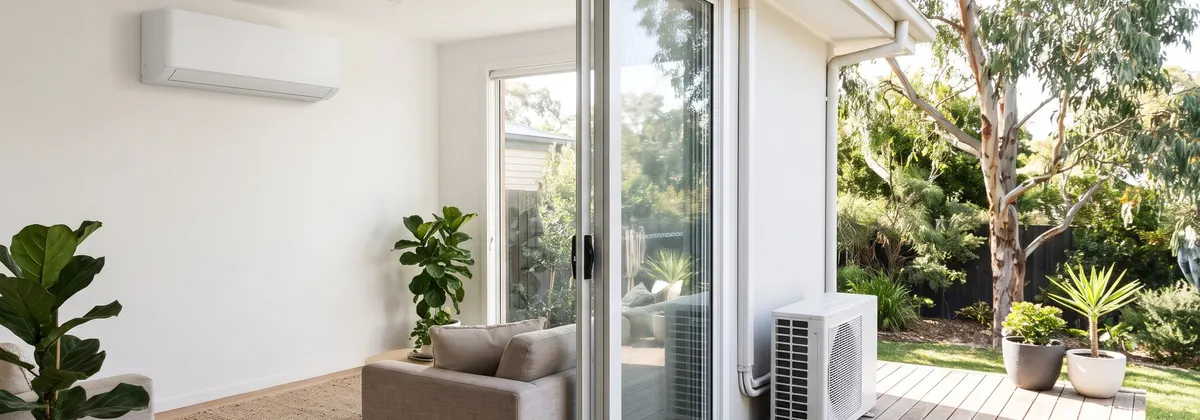
Refrigerated air conditioning is the technology in split systems, ducted systems, window units and portable units. It moves heat rather than making cold. A refrigerant gas is pumped around a sealed circuit, absorbing heat from the indoor air and releasing it outside.
Because it moves heat instead of generating cooling, a refrigerated air conditioner is remarkably efficient. On the Australian market, reverse cycle systems deliver roughly three to six units of heating or cooling for every one unit of electricity they use (energy.gov.au).
Reverse cycle models run the same circuit in reverse to heat the house in winter. Most refrigerated systems sold in Australia today are reverse cycle.
Where refrigerated air conditioning suits
Refrigerated works in any Australian climate, including humid ones, which is its main advantage over evaporative cooling. It also removes moisture from the air as it cools, so it makes a muggy day feel noticeably better.
Because the house is closed up while it runs, it also filters the air as it circulates, which many people with allergies or asthma find helpful.
What form does it come in?
Refrigerants: what you need to know
Older systems used R22, which did damage the ozone layer and has been phased out. The refrigerants used in air conditioners sold in Australia today, R32 and R410A, do not deplete the ozone layer. They are hydrofluorocarbons, and the environmental concern with them is global warming potential, not ozone.
Most new split systems now use R32, which has roughly one third the global warming potential of the R410A it replaced. Australia is progressively reducing imports of high global warming potential refrigerants, so R32 and other lower-impact refrigerants are becoming the norm.
R32 is classified as mildly flammable (safety class A2L), which is one of several reasons installation and servicing must be done by a technician holding a Refrigerant Handling Licence.
You do not need to choose your refrigerant. It comes with the model. But it is a fair question to ask an installer, because a system on a refrigerant being phased down may become dearer to service in future.
Advantages of refrigerated air conditioning
- Works in any climate, humid or dry
- Reverse cycle models heat as well as cool, which makes them the cheapest way to heat most Australian homes
- Very efficient: roughly three to six units of heating or cooling per unit of electricity (energy.gov.au)
- Removes humidity as it cools
- Filters the air as it circulates, which many people with allergies or asthma find helpful
- Precise temperature control
- Single split systems carry a Zoned Energy Rating Label, so efficiency and running costs are easy to compare before you buy
Disadvantages of refrigerated air conditioning
- Costs more to buy and install than evaporative cooling
- Costs more to run than a ducted evaporative cooler of similar capacity
- Windows and doors must stay shut while it runs
- Recirculates indoor air rather than bringing in fresh air
- Uses refrigerant gas, which must be installed, serviced and removed by a licensed technician
- The outdoor unit makes noise that can affect neighbours
Inverter or non-inverter?
Most refrigerated systems sold today are inverter models. An inverter varies the compressor speed rather than switching it on and off, which means lower running costs, steadier temperatures and quieter operation. Non-inverter models are cheaper up front and are now mostly confined to entry-level and window units.