
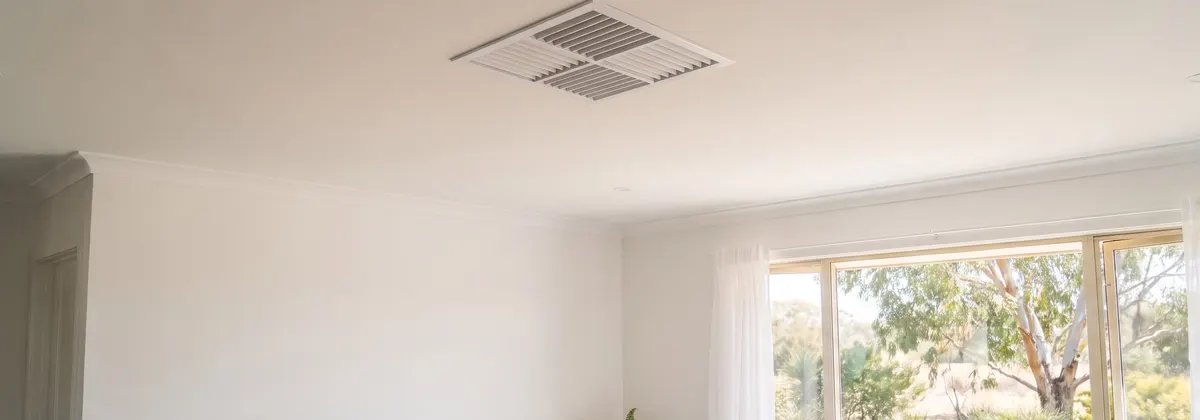
Evaporative cooling comes in three forms: ducted whole-house systems, fixed room units and portable coolers. They differ enormously in cost and in how well they actually work.
Not sure whether evaporative suits your climate? Start here
Ducted evaporative (whole house)
A unit mounted on the roof draws in outside air, cools it through wet pads, and distributes it through ducts to vents in each room. Hot indoor air is pushed out through open windows and doors.
- Suits: whole homes with enough roof space, in dry-summer climates
- Power use: a ducted evaporative cooler uses less than half the electricity of a refrigerated air conditioner of similar capacity (energy.gov.au). Models with inverter-driven fan motors use less again, especially on lower fan speeds
- Indicative cost: budget from about $5,000 supplied and installed for a typical home. Most of that is the ducting and vents rather than the unit itself. Larger homes and difficult roof access cost more
Points to check before you commit:
- Existing gas ducted heating ductwork cannot be reused for evaporative cooling. It is a separate duct system
- The unit needs a plumbed water supply run to the roof, and some installations need a wastewater connection
- You need a way for the air to escape. Rooms that are shut off will not cool
- Check your local water restrictions
- The roof unit is exposed to weather and needs a service at the start of each season
Fixed room unit
A single unit fitted to an external wall or window, permanently wired and plumbed, cooling one room or open area. Best positioned to face the prevailing summer breeze.
- Suits: a single open area
- Ask your installer to quote both this and a comparable split system, since the price gap is often smaller than people expect
Portable evaporative cooler
A wheeled unit you fill with water, available from most retailers for a low price. It is the least effective of the three by a wide margin.
The problem is that a portable cooler recirculates the same indoor air and keeps adding moisture to it. Without a good flow of air out of the house, the room gets progressively more humid, and heat from the unit’s own motor can end up making it feel warmer rather than cooler.
- Suits: a small room with a window or door open on the far side, or outdoor and semi-outdoor areas
- Do not expect it to cool a closed room
How much water does an evaporative cooler use?
More than most people expect, and it varies a great deal with climate, model and fan speed.
The Australian Government puts typical use at up to 25 litres an hour (energy.gov.au). The Government’s YourHome guide says a whole-house system can use 25 litres or more an hour on hot, dry days, which over a long, hot day runs to several hundred litres.
The practical advice is to ask your installer for the expected hourly water use of the specific model, for your city, before you sign. In an area with water restrictions or on tank water, this may decide the question for you.
Which should you choose?
| Ducted evaporative | Fixed room unit | Portable | |
|---|---|---|---|
| Area covered | Whole house | One room or open area | Part of one room |
| Effectiveness in dry heat | Good | Good | Limited |
| Installation | Roof unit, ducts, plumbing | Wall or window, wired and plumbed | None |
| Indicative cost | From about $5,000 installed | Get a quote | Low, but low value |
Cost figures are indicative only. We last reviewed them in October 2026. Get quotes for your own home before budgeting.
Brands to compare
For who makes ducted evaporative coolers in Australia, their warranties and how they differ, see evaporative cooler brands compared.