
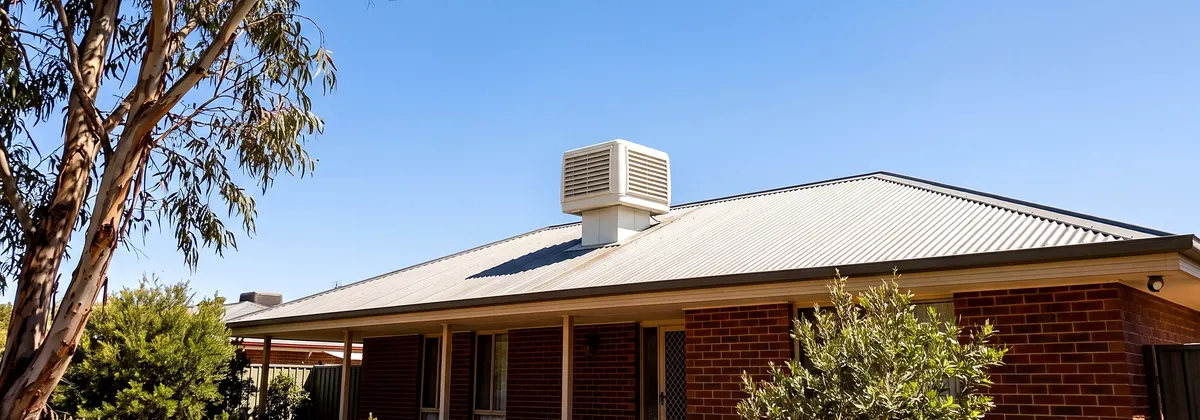
Evaporative cooling is a much bigger part of the market in Perth, Adelaide and inland Australia than it is nationally, and the evaporative cooler brands are different from the ones you see in split systems. The split system brands are mostly absent. The names that matter here are mostly Australian.
That is not marketing sentiment. Evaporative cooling suits hot, dry climates, so the companies that took it seriously are the ones based in them.
Before you read this page make sure evaporative cooling is right for your climate at all. It loses effectiveness as humidity rises, and it cools only. Start here if you are not sure.
Who makes what
The main ducted evaporative brands come from three manufacturers.
| Brand | Made by | Notes |
|---|---|---|
| Breezair | Seeley International | Seeley’s premium evaporative range |
| Braemar | Seeley International | Seeley’s mainstream range. Also sold as ducted gas heating and refrigerated |
| Coolair | Seeley International | Seeley’s entry range |
| Brivis | Rinnai Australia | Long-established |
| Bonaire | Climate Technologies | Long-established: “since 1954”, says Bonaire |
If two quotes name Breezair and Braemar, you are comparing two ranges from the same manufacturer, not two competing companies. Worth knowing before you treat them as independent opinions.
Seeley International: Breezair, Braemar and Coolair
Seeley International was founded in 1972 by Frank Seeley AM, who remains Executive Chairman. It is 100% Australian owned and describes itself as Australia’s largest air conditioning manufacturer, exporting to 100 countries (seeleyinternational.com).
Manufacturing is at Lonsdale in South Australia and Albury in New South Wales, and the head office is at Lonsdale.
For an evaporative buyer, the Australian manufacturing is not a patriotic point. It means parts availability and service agents, which matter on a roof-mounted unit you expect to keep for fifteen years or more.
Breezair (premium)
| Model | Cooling capacity | Airflow |
|---|---|---|
| Extraordinaire | up to 17.4kW | up to 2,900 L/s |
| SuperCool | up to 15.1kW | up to 2,540 L/s |
| Icon | up to 14.5kW | up to 2,540 L/s |
The Extraordinaire is the flagship. Its distinguishing feature is a cabinet designed to sit flat on roof pitches from 10 to 40 degrees, so it sits lower and is less visible from the street. If the look of a box on your roof is a sticking point, this is the range that addresses it.
It also carries Seeley’s SuperStealth inverter-driven fan motor, which reduces noise and running cost at low speeds.
Braemar (mainstream)
| Model | Cooling capacity | Airflow |
|---|---|---|
| SuperStealth | up to 14.3kW | up to 3,070 L/s |
| Evolution | up to 13.2kW | up to 2,850 L/s |
The Evolution is an ultra-low-profile cabinet, again aimed at reducing how visible the unit is on the roof.
Coolair (entry)
Seeley’s entry-level evaporative range. Lower specification and a shorter warranty than Breezair and Braemar, covered below.
Controls
Breezair and Braemar models use Seeley’s MagIQtouch touchscreen wall controller, with a Wi-Fi app for phone control and compatibility with Amazon Alexa and Google Home. The app handles on and off, temperature, fan speed and zoning.
Warranty, and the conditions worth reading
Seeley’s headline warranty is strong, but the conditions matter more than usual here.
| Range | Comprehensive | Structural | Corrosion (Permatuf cabinet) |
|---|---|---|---|
| Breezair, Braemar | 7 years* | 10 years | 25 years |
| Coolair | 5 years | 10 years | 25 years |
| Portable evaporative | 2 years |
The asterisk is important Seeley states that the 7 year comprehensive warranty on Breezair and Braemar applies only if the product is first purchased from Seeley International through a participating Seeley dealer. If it is bought through a distributor, wholesaler or trade installer instead, the residential warranty period is 5 years, not 7.
There are two more conditions: you must register the product online within the first 6 months, and it must have a general maintenance service performed by Seeley International or its nominated appointee within the fourth year from purchase, which Seeley charges for. The Coolair 5 year warranty applies to purchases from 1 Oct 2020 and has service requirements too (Seeley warranty information).
Neither condition is hidden, and a 7 year warranty is still a good warranty. But it means two things for you:
- Ask your installer directly whether they are a participating Seeley dealer, and get the answer in writing. It is the difference between 5 and 7 years of cover.
- Register the product within 6 months, and budget for the year-four service. Miss either and you may lose the extended cover.
This is exactly the kind of warranty condition we tell people to check on every brand. More on warranty questions to ask.
Running cost claims
Seeley markets Breezair and Braemar as saving up to 80% on running costs compared with a ducted reverse cycle air conditioner.
For context, the Australian Government’s own guidance is that a ducted evaporative cooler uses less than half the electricity of a refrigerated air conditioner of similar capacity (energy.gov.au). Both statements point the same way, and evaporative is genuinely much cheaper to run. The 80% figure is the manufacturer’s own, under its own assumptions, so treat it as a best case rather than what you should expect on your bill.
Brivis (Rinnai Australia)
Brivis is one of Rinnai Australia’s brands. Rinnai has been in Australia for over 50 years and is a subsidiary of Rinnai Japan Corporation (rinnai.com.au). Its other brands include Rinnai, APAC and Polo.
Brivis is part of Rinnai, so it often comes up where ducted gas heating is paired with ducted evaporative cooling.
The Brivis range
Five ducted evaporative series: Contour 7, Contour 6, Promina, Advance and Balaero, each with several capacity options.
The bushfire option
This is Brivis’s genuine point of difference, and it matters if you live somewhere it matters.
A roof-mounted evaporative cooler is an ember entry point in a bushfire. Standard units are not built for it. The Balaero series is engineered with stainless steel ember protection to meet Bushfire Attack Level (BAL) 12.5.
If your property has a BAL rating, this is not optional detail. Ask your installer:
- What BAL rating applies to my property?
- Is the unit you are quoting rated for it?
- Are ember guards included, and will they be signed off before the building certifier inspects?
Requirements get stricter at higher BAL levels, and getting this wrong can mean failing an inspection or, much worse, an ember entry point in a fire. Confirm the requirement with your local authority as well as your installer.
Brivis warranty
Brivis runs a Service Advantage Program, which provides extended parts and labour cover when you register the product and complete the scheduled servicing. All Brivis products are eligible.
As with Seeley, the extension depends on you doing something. Ask what the servicing schedule is, what it costs, and what happens if you miss one.
Bonaire (Climate Technologies)
Bonaire is made by Climate Technologies Pty Ltd, and the brand dates to 1954, so it is one of the longest-running names in Australian heating and cooling.
The Bonaire range
Ducted evaporative coolers in the Silhouette SVS, Integra II and Summer Breeze series, and a substantial portable evaporative range.
Silhouette features include Bonaire’s Humidity Management System, 120mm Filtercool filter pads, the Aerowing fan, and PreCool and Pad Clean functions.
Bonaire also sells ducted and split refrigerated systems, and as of 2026 has reverse cycle models approved under the Victorian Energy Upgrades program, which matters if you are in Victoria and want the rebate.
Bonaire warranty
There is a base warranty, plus a Climate Care two-year extension if you apply within 6 months of installation and have a paid service by a Bonaire-authorised technician (Bonaire warranty).
Ask for the base term in writing for the specific model you are quoted, and what the extension requires.
How to actually compare evaporative quotes
Capacity in kW and airflow in litres per second are the two numbers that matter, and installers do not always lead with both.
Ask every quote for:
- Cooling capacity in kW and airflow in L/s for the specific model
- Whether the motor is inverter-driven. Inverter fan motors use much less power at low speeds, which is where an evaporative cooler spends most of its time
- Expected water use per hour for your city. This varies a great deal with climate and model, and it is the running cost nobody quotes you
- Warranty term, and every condition attached to it. As above, several brands offer a longer warranty that depends on where you bought it or on paid servicing
- What the annual service costs, and whether the first one is included
- How the air will get out. Evaporative cooling only works if the warm indoor air has somewhere to go. Ask how many outlets, and what your installer expects you to leave open
- Roof suitability. Pitch, structural support, and access for future servicing
- BAL rating, if your property has one
A note on independent ratings
There is much less independent testing of evaporative coolers in Australia than there is of split systems.
Evaporative coolers are not covered by the Zoned Energy Rating Label, so there is no star rating to compare and no published annual energy figure. The Australian Government’s Energy Rating register, which our other brand pages draw on, does not cover them either.
That means you are relying more on the specifications, the warranty terms and your installer than you would be with a split system. It is a reason to compare every quote you are given rather than stopping at the first, and to weight the questions above heavily.
A reminder about installation ducted evaporative cooling involves roof work, electrical work and plumbing. Use licensed trades. If you are also considering a refrigerated system, note that refrigerated installation additionally requires a technician holding a Refrigerant Handling Licence from the Australian Refrigeration Council. You can check any installer’s licence on the national register at lookforthetick.com.au.