
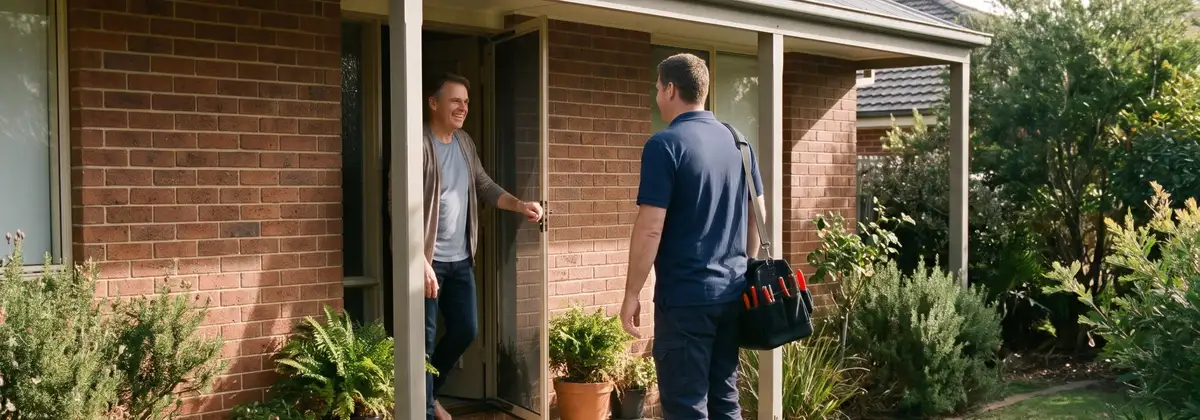
Check the installer’s refrigerant licence on the national register, expect them to visit your home before they quote, and get a detailed quote in writing.
The installer matters more than the brand. Refrigerant charge, pipe runs, drainage, duct sealing and where the outdoor unit sits all decide how well your system works and how long it lasts. A good installer with a mid-range unit will beat a poor installer with a premium one. Do not just take the cheapest quote. Here is what to look for.
How to check an installer’s licence
In Australia, anyone who installs, services or decommissions a refrigerated air conditioner must hold a Refrigerant Handling Licence issued by the Australian Refrigeration Council. Businesses that buy, store or dispose of refrigerant also need a Refrigerant Trading Authorisation. Handling refrigerant without a licence is an offence.
Three ways to check:
- Use the licence check and business search at lookforthetick.com.au
- Ask to see the technician’s licence card, which shows what work they are permitted to do
- Look for a licence number in the business’s advertising
The two licences that matter for homes
| Licence | What it allows |
|---|---|
| RAC01 (full refrigeration and air conditioning) | Install, service, repair and decommission any type of air conditioning |
| RSS03 (restricted, split systems) | Install and decommission a single-head split system under 18kW only. Does not permit servicing or repair |
This distinction matters. If you are having a multi-split or a ducted system fitted, or you want the same business to service it later, you need someone holding the full RAC01 licence.
Electrical work must be done by a licensed electrician. On many jobs the installer holds both, but ask.
What a good sales process looks like
They visit before quoting Every home is different, and a quote based on floor area alone is a guess. Your installer should do a heat load assessment that accounts for room sizes, ceiling height, insulation, building materials, and the size and orientation of your windows.
They explain the options A good installer will tell you why they recommend one system over another, and will quote alternatives if you ask. Someone who only ever recommends the most expensive option is selling, not advising.
They do not pressure you Nobody should be telling you the price is only good today. A reputable business will give you time to compare quotes.
The quote is detailed and in writing It should itemise the equipment, the installation, any electrical work, and anything else. Ask specifically what is not included and what could add to the price once work starts.
Questions the quote should answer
- Exactly which models, indoor and outdoor, by model number
- Where the indoor and outdoor units will sit
- Whether electrical work or a switchboard upgrade is needed, and whether it is included
- For ducted: how many zones, which rooms are grouped, whether duct sealing and dampers are included, and the R-value of the duct insulation
- Who removes and disposes of the old system, and whether the refrigerant recovery is included
- Commissioning and warranty registration
- Payment terms
Warranty
Ask about two warranties, because they are different things:
- The manufacturer’s warranty on the equipment. Check whether it covers parts and labour or parts only, and how long for. Five years parts and labour is common on major brands
- The installation warranty from the installer, covering their workmanship
For either, ask who pays for freight if a part has to go back to the manufacturer, and who pays for the labour to fit the replacement. If a business cannot tell you, or it is not in their terms, that is a reason to walk away.
Be wary of a condition requiring you to buy an annual service from that installer or the installation warranty is void. Ask for that in writing and read it carefully.
Warning signs
- No licence number, or reluctance to show a licence card
- A quote without a site visit
- Pressure to sign today, or a discount that expires the same day
- No fixed address and no way to reach a person by phone
- A verbal quote, or a quote with no itemisation
- A deposit demand for most or all of the price before work starts
- No written warranty terms
Good signs
- They turn up when they said they would, or call ahead
- They walk you through the job before starting and confirm you are happy
- They demonstrate the controls on completion and leave the manuals
- They clean up and take the rubbish
- They provide compliance certificates and warranty documentation
- They follow up after installation, and can be reached when you call
Your consumer rights
Whatever the warranty says, you have rights under Australian Consumer Law that cannot be excluded. Goods must be of acceptable quality and fit for purpose, and services must be provided with due care and skill. If something goes seriously wrong, those rights apply regardless of what a warranty document states.
If you cannot resolve a dispute with an installer, your state or territory consumer affairs or fair trading body can help. For unlicensed refrigerant work, contact the Australian Refrigeration Council.